
Special: noun: one that is used for a special service or occasion. Adjective: designed for a particular purpose or occasion.
Going by Meriam Webster’s definition, a special charger is called for when charging any battery type. In the early days of AGM batteries, when almost all the existing chargers ran on hand wound timers, and could go on charging indefinitely, you very much needed a special charger. When you plugged a battery into one of those dinosaurs, it was constant current, constant voltage, until the electrolyte had a good boil!
Fortunately, there’s a huge offering of various types of chargers in the marketplace today, some better, some worse. We’ll do a quick review of what to look for when choosing the right charger.
AGM Charge Profile (Algorithm)
First, look for a charger that has a specific setting for AGM. It’s best to avoid chargers that claim to charge any battery with one algorithm. Most “one size fits all” products typically only do a mediocre job at best when they try to account for everything under one umbrella.
Amp Output
Second, you need to right-size the charger to go with the capacity of your battery bank. The rule here is a minimum of 10%, but Fullriver recommends 25% of rated capacity in amps for circuits in parallel. For example, if you’re using our DC55-12, this battery has a capacity of 55Ah. You will want to find a charger that puts out at least 5.5 amps, but ideally 13-14 amps. If you have 2, DC55-12’s in a parallel string (12V, 110Ah) you’ll need at least 11 amps, but better if you have 22 amps. Conversely, you don’t want to throw too many amps at the battery, or you’ll run the risk of an early failure. While 25% of rated capacity is ideal, we don’t recommend more than 30% if you need to charge a bit faster. Why? It has a lot to do with surface area. Imagine trying to fill a tea pot with a fire hose.
Phased Charging
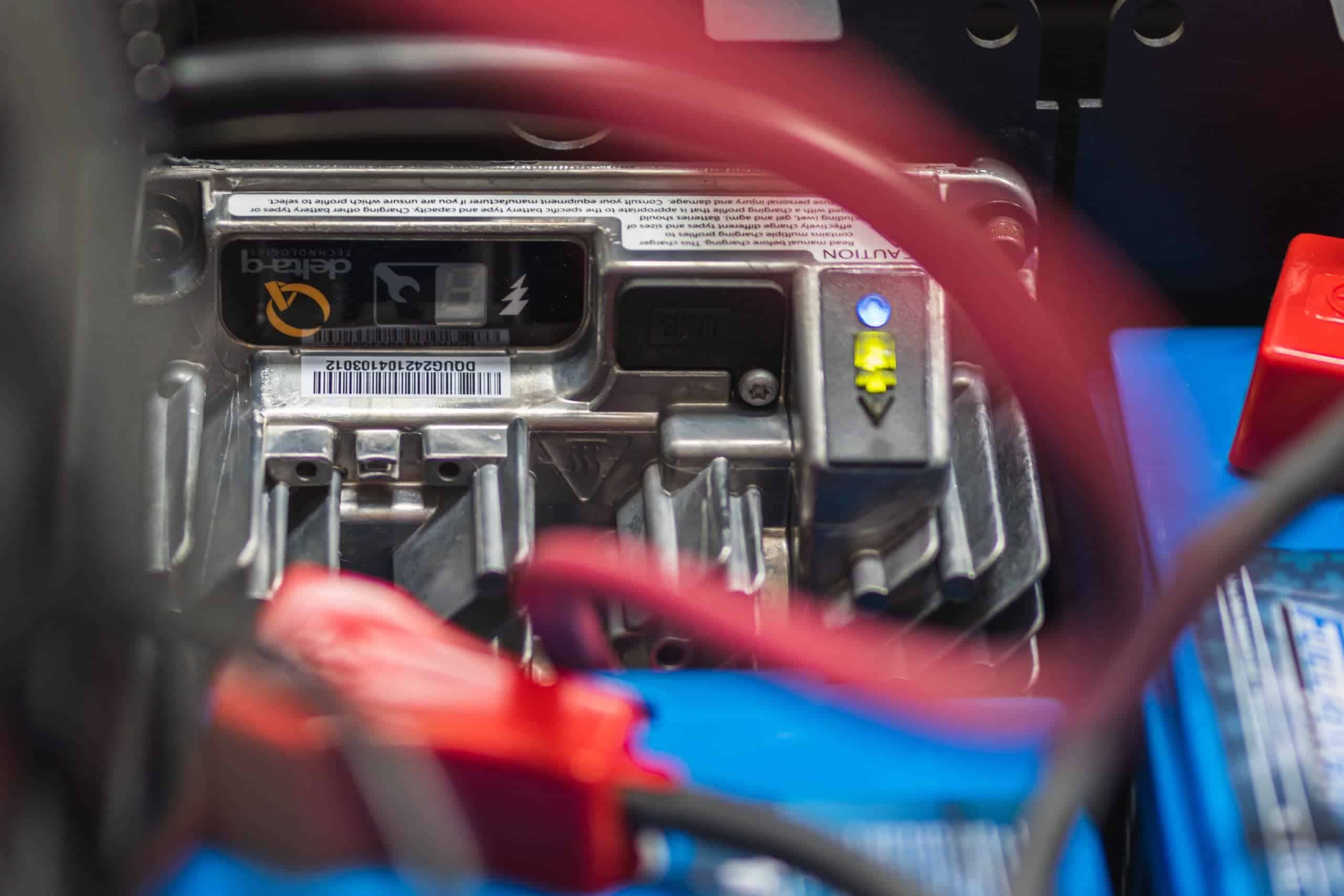
Third, if it’s a reputable charger, it will charge the battery in phases to ensure the battery is fully and efficiently charged every time. A prominent example of a single-phase charger would be the alternator in car or truck. An alternator was primarily designed to top-off the vehicle battery after it fulfilled its primary task of starting the vehicle. A car’s alternator lacks the distinctive phases of absorb and finish/float that ensure a battery is balanced and fully charged, especially important in charging a deep-cycle battery. The charger should have at least 3 phases of charging, Bulk, Absorb, and Finish/Float. Some chargers will have a recovery phase in case the battery is inadvertently over-discharged and showing very low voltage.
Voltage Parameter
Finally, attention should be given to the voltage of a given charger at each phase of the charging cycle. AGM in general, and Fullriver AGM in particular takes a bit higher voltage range in the first two phases of charging (Bulk and Absorb) than a gel type battery but needs a lower float/finish voltage. Most charger makers readily share their voltage for each phase of charging. If you don’t see it anywhere obvious, a simple email to the manufacturer will usually do the trick.
The table below shows Fullriver’s acceptable voltage range, with the numbers in bold being our recommended voltage:
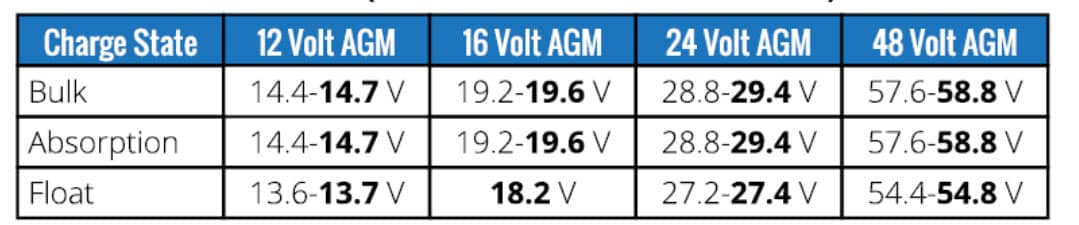
In summary, we have seen that pairing the right sized charger and battery can make a great difference in charging a battery as
The impact of these voltages will have less of an impact in lighter applications like RV and will be more critical in heavy use applications like golf/ev.
Fullriver Can Help
Fullriver offers a wide range of chargers with verified algorithms to ensure great charging results. If you’re having trouble finding the right charger for your application, please contact us and we will point you in the right direction.
We want to hear from you. Tell us your charging story. Did you know so much went into charging a battery?
